
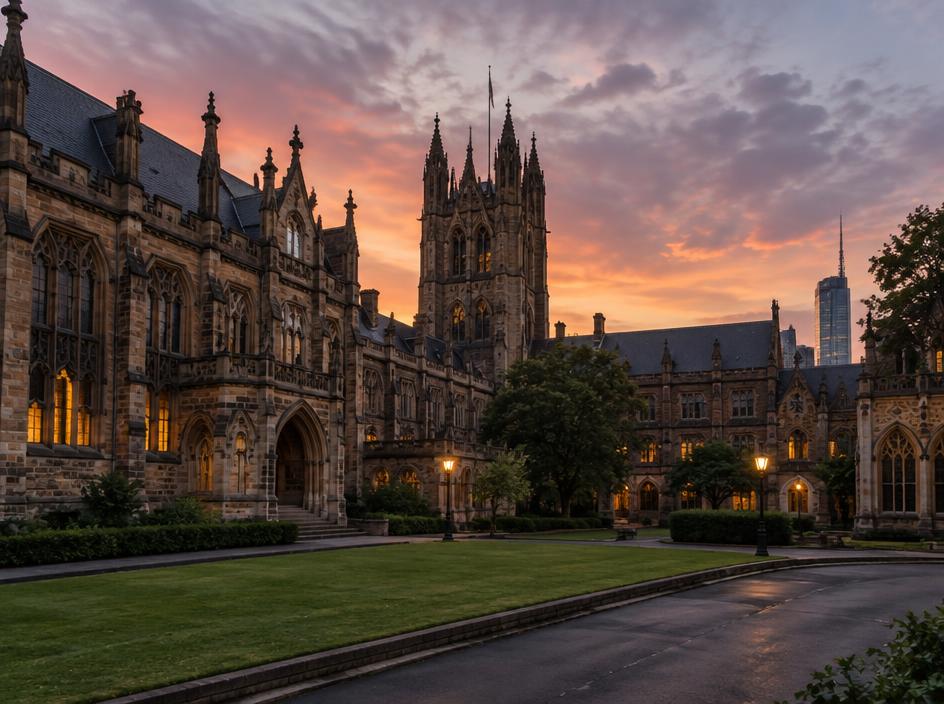
Plan your studies
Programs & course selection
Research & professional studies. Compare course content, teaching language, and qualifications against your goals.
Admissions & recognition
Compare academic prerequisites, English requirements, and professional accreditation. Medical pathways may require additional tests and a different application process.
Budget & scholarships
Review tuition and living costs in the city you choose. University scholarships can be competitive and may cover only part of your expenses.
Study in Australia
Study in Australia offers students a world-class educational experience in a dynamic, multicultural environment. Australia draws students from all over the world because of its top-notch universities, cutting-edge research possibilities, and extensive course offerings. Beyond academics, the nation is a prime location for personal and academic growth due to its magnificent natural scenery, warm towns, and high standard of life. No matter what topic of study you're pursuing—science, the arts, business, or another—Australia offers a vibrant, welcoming atmosphere where you may flourish academically while taking in the country's diverse culture.
Dear Students /Parents,
Greetings from Global Circle……!!
We would like to inform you regarding the Australia Study visa program. The process of Student visa Sub class 500 category is very easy & the visa success ratio is very high.
The International students can get their study VISA processed in quick time. Students who fall under the following criteria canapply.
Age:
No Age limitation, Ideally 6 Years & above, you can apply an Australia Study Visa at any age
Qualification:
Primary orSecondary School / 12th / All Diploma holders (10+3, 10+2+3)/ All Bachelor degrees / All Master Degrees (Percentage/Backlog will vary from College to College / University to university–someColleges/Universityacceptevenhighernumberofbacklogswithexplanation)
IELTS Academic:
Overallbandof5.5withnoindividualbandlowerthan5.0forDiplomaprograms Overall6.5/6.0bandnolessthan6.0/5.5requiredforBachelor/MasterPrograms(Mayvaryforsome institutes as wellcourse)
College Fees:
AUD $15,000 to $ 30,000 for 1 Year (2 Semesters) Tuition fees. *Depends on programs selected Student has to pay 1 Semester / 6 Months tuition fees in advance before applying for VISA.
Visa Process Time:
1 Minutes to 28 days for visa process once you Apply
OSHC:
International students enrolled in formal education programs in Australia, as well as their dependents (such as spouses and kids under 18), are required to have OSHC. It covers doctor visits, certain hospital care, ambulance coverage, and a small amount of pharmaceuticals (medicines). Visit www.privatehealth.gov.au to find out more about OSHC, including a list of the providers.
| Health Insurer | Insurers website |
|---|---|
| AHM OSHC | www.ahmoshc.com |
| Allianz Global Assistance (People care Health) | www.allianzassistancehealth.com.au/en/student-visa-oshc/ |
| BUPA Australia | www.bupa.com.au/health-insurance/oshc |
| CBHS International Health | www.cbhsinternationalhealth.com.au/overseas-students-oshc |
| Medibank | www.medibank.com.au |
| NIB OSHC | www.nib.com.au |
Post Study Work Visa Rules In Australia
| DEFINITION | LOCATIONS | INCENTIVES FOR INTERNATIONAL STUDENTS |
|---|---|---|
| MAJOR CITIES | SYDNEY<br> MELBOURNE<br> BRISBANE | Regular2YearsPostStudyWorkVisafor international students completing Bachelors and Master’s Degree(minimum 92 weeks), 3 Years for Masters by Research & 4 Years for PhD. Graduates |
| CITIES & MAJOR REGIONAL CENTRES | PERTH<br> ADELAIDE<br> GOLD COAST<br> SUNSHINE COAST CANBERRA<br> NEWCASTLE / LAKE<br> MACQUARIE<br> WOLLONGONG / ILLAWARRA<br> GEELONG<br> HOBART | International students studying at regional university will be eligible to access anadditional yearinAustraliaon a Post-Study WorkVisa (which means aBachelors or Masters graduates cangetupto 3years ofPSW Visa) |
| REGIONAL CENTRES & OTHER REGIONAL AREAS | ALL OTHER LOCATIONS<br> (LIST OF CITIES) | International students studying at regional universities will be eligible to access an additional2YeasinAustraliaonaPost-Studyworkvisa(whichmeans aBachelors orMasters graduates can get up to 4Years of PSW Visa) |
Process Flow & Timeline for Australia Study Visa
IELTS or PTE
Academic
2 Months Min.
Admission Process / LOA
10-15 Working Days
GTE Requirement & Financial Documentation
10-15 Days
Medical Examination
1 Day
Payment of Visa Fees
1 Day
Tuition Fees Payment
1 Day
Visa Form Filling & Submission
Max. 5 Days
Total Process Duration
1-2 Months approx. after applying for LOA
Better Start Planning Before 6 months of Preferred Intake
Major Intakes
January / April / July / November
Financial Requirements For an Australian Student Visa?
The applicant must have sufficient funds that are actually accessible to cover course tuition, as well as travel and living expenses for the student and any accompanying family members while the applicant is studying in Australia. The student's application for an Australian student visa may be rejected if the student fails to submit this documentation of financial capability when requested to do so by an officer.
One of the following will be provided by the applicant to prove this:
Option 1:
Evidence showing sufficient cash for the student's flight to Australia, as well as the costs of living, attending classes, and paying for the education of any dependents who are still in school for the entire year
Option 2:
Evidence that you meet the annual income requirement
OPTION 1: TWELVE MONTHS' FUNDS OPTION
Majority of Indian student demonstrate their financial capacity by providing Evidence of funds for the first 12 months of study. You must provide proof of enough money to pay for the student's flight to Australia, as well as the costs of their course fees, housing, and (if they have dependent children) a year's worth of schooling.
The 12-month living cost is:
- Student: AUD 21,041
- Partner/Spouse: AUD 7,362
- Child: AUD 3,152
- Travel Cost: About 2,000 AUD $
Schooling costs for your children:
Where school-aged children are included in your student visa application, schooling costs of at least AUD 8,000 per year for each child will need to be added to the amount of funds required. You are responsible for researching schooling costs, which vary between states, territories and schools in Australia.
For Example:
Mr Krunal Patel is a Single student going for Bachelor of IT of 3 years having fees of 16,000 A$ per year. He needs to show fund: 16,000 A$, +21,041 A$, + 2000 A$ = 39041 A$
Mr Yash Shah is Married and going for Master of Professional accounting of 2 years duration having fees of 21,000 A$. He needs to show fund: 21,000 A$. + 21,041 A$, + 7,362 A$, + 2000 A$, + 2000 A$ = 53403 A$
Mr Lokesh Gupta is Married and having one children of 1.5 years going for Master of Business of 2 years duration having fees of 27,000 A$. He needs to show fund: 27,000 A$. +21,041 A$ +7,362 A$ + 3,152 A$ + 2000 A$ + 2000 A$+ 2000 A$ = 64555 A$
Note: Please subtract any sums paid in advance for tuition in order to determine the precise amount of funding needed for an Australian student visa.
Acceptable Evidence to fulfil financial requirements of Australian student visa includes:
Deposits of money in a financial institution (savings accounts, fixed deposits, etc.)
A loan with a financial institution
If you have money in a cooperative bank, post office, PF/PPF, etc. then Transfer fund to a valid bank and keep proof of source of fund (Post office, PF/PPF, Co-operative Bank etc…)
Government loans; and Scholarship or financial support
Genuine access to funds
You and your accompanying family members must be able to access the funds shown while you are in Australia. When considering whether the funds will be genuinely available, DIBP will take into account: The nature of the relationship between you and the person who is providing the funds, where applicable Your income, assets and employment or those of the person providing the funds, your previous visa history and that of the person providing the funds
Note: Relationship of a student with Person having a fund and Acceptable source of Fund is most important for Australian Student visa.
OPTION 2: ANNUAL INCOME OPTION
This annual income option requires an applicant to provide evidence of personal annual income of at least AUD 60,000. The income demonstrated must be the personal income of student’s parents OR spouse (who is not coming with student). Where both of student’s parents are working, their combined income can be considered for this requirement. Evidence must be in the form of official government documents such as tax assessments (IT Returns). Evidence in the form of bank statements or information directly from an employer is not acceptable.
For students accompanied by family members, the requirement is at least AUD 70,000.
GENUINE TEMPORARY ENTRANT (GTE) REQUIREMENTS
Under GTE requirement, Student must satisfy the condition that he has a genuine intention to stay in Australia temporarily. Profile of Student and Statement of Purpose / GTE Statement is a key to fulfil the GTE Criteria. The GTE requirement applies to all visa applicants
When assessing the GTE requirement, DIBP / DHA (Department of Home Affairs Australia) will considerthe requirements set out in direction number 69. To assess this, they will consider:
Circumstances of Student (Education, Family Income, Employment etc…)
Visa / Immigration history. / Any other relevant matter.
The Department of Home affairs use GTE requirement to identify visa applicants who are not potential genuine students. They want to stop student visa applicants who want to use the student visa route for motives other than gaining a quality education. The requirement is not designed to exclude students who, after studying in Australia, go on to develop the skills required by the Australian labour market and apply to become permanent residents
The case officer assessing the visa will consider whether the individual circumstances of the student indicates that their intention is for a temporary stay to study in Australia. The genuine temporary entrant (GTE) requirement is an integrity measure to ensure that the student visa programme is used as intended and not as a way for international students to maintain ongoing residency in Australia.
For Example: If you have previous Australian Student visa refusal, Majority of Overseas Education consultant for Australia and Australian Universities will refuse to process your application. Similarly in your graduation, if you had too many Backlogs OR Poor education credentials, Majority of Overseas Education consultants and Australian Institutes will refuse to process your application.
TOP 10 REASONS FOR STUDYING IN AUSTRALIA
- Studying in Australia is a fantastic way to further your education and boost your career prospects.
- Australia is the third most popular international student destination in the world.
- We might be a small country of 25 million people but we’re world leaders in education.Australia is soon expected to take over the UK as the world’s second most popular study destination, just behind the US, according to the University College of London’s Centre for Global Higher Education.
- Australia is currently home to nearly 700,000 international students.Australia is currently home to nearly 700,000 international students.
- Australia is currently home to nearly 700,000 international students.
- That’s an 11% increase in international student numbers from 2017.Our high-quality education, easy access to student support services, multicultural society and fantastic lifestyle make Australia an attractive study destination.
- We have 12 of the world’s top 200 universities.
- Our education institutions may be relatively young compared with universities such as the UK’s Oxford or the US’s Harvard but they are up there with the best. The University of Melbourne, Australian National University, University of Sydney, University of Queensland, University of New South Wales and Monash University were all ranked in the top 100 universities in the Times Higher Education World University Rankings 2020.
- We have one of the best higher education systems in the world.
- Australia has an outstanding higher education system. With over 22,000 courses across 1,100 institutions, our system is ranked 8th in the Universities 2019 U21 Ranking of National Higher Education Systems, higher than France, Germany, Norway and Japan.
- An emphasis on student experience and graduate outcomes.
- International students report almost 90% satisfaction scores for their living and study experience in Australia according to the 2018 Department ofEducation International Student Survey. Seven of the best student cities in the world are in Australia.
- We already knew our cities were great places to live and study but now it’s official! According to QS Best Student Cities 2019, almost all of our major cities – Melbourne, Sydney, Brisbane, Canberra, Adelaide, Perth and the Gold Coast – are in the world’s top 100 student cities
- The Australian Government has invested over a $300 million in scholarships for international students. Australia offered over 3,000 Australia Awards scholarships and short courses to students from over 55 countries in 2019. You could be eligible for one in 2020.
01\. Australian Universities rank in the world’s 50 in a huge range of study areas.
Australia provides world-leading education in many study areas. The Times Higher Education World University Rankings 2020 rated our institutions highly in the following fields:
Arts & Humanities
Clinical, Pre-Clinical & Health
Engineering & Technology
Life Sciences
Physical Sciences
Social Sciences
Over the past 50 years, 2.5 million international students have graduated from Australian educational institutions, according to the International Education Association of Australia. These graduates are now part of a global alumni network that is making an impact around the world.
2\. Australian Universities have produced 15 Nobel laureates.
From the 1945 prize for the discovery of penicillin to the most recent prize in 2017 for the International Campaign to Abolish Nuclear Weapons, Australian graduates are high achievers. Will you be Australia’s next Nobel laureate?
3\. Discover how to be an innovative, agile thinker
Australian universities, colleges and schools are committed to equipping you with practical skills and knowledge to help you succeed in your chosen industry. As global demand booms for entrepreneurial and innovative thinkers, Australian education providers have re-engineered their approaches to teaching and learning to inspire thought-leading creativity among students in every discipline. Australian universities, colleges and schools will teach you the practical skills and theoretical knowledge to help you succeed in a fast-changing world and remain agile in uncertain times.
4\. Study at globally ranked institutions
Australia is setting international standards for excellence in education. The Australian education sector comprises world-leading education institutions, premium training facilities, and outstanding lecturers and student support services. If you’re looking for unbiased proof that Australian universities truly are world-class, look at independent global rankings such as Times Higher Education, QSand Shanghai Rankings. These organization’s consistently rank Australian institutions in the world’s top 100 universities year after year.
5\. Gain work experience while you study
Australian institutions provide an education designed to help you succeed in the global workforce. An Australian qualification will make you very attractive to potential employers in Australia, at home and around the world. Many Australian degrees and vocational courses include work experience programs and internships so you can gain hands-on industry experience and grow your professional network while you study.Once you complete your degree, you may also be eligible to stay and work in Australia. While studying, you can work up to 20 hours per week during the semester and full-time during the semester break.This can be agreat way to find study-related work or simply payfor yourlifestyle in Australia.
6\. Access extensive student support services
Australian institutions offer a huge range of student support services to help you settle into your new life in Australia. Education providers must comply with strict quality control and government accreditation measures so you can be assured you will receive only the best service. In several cities and towns, there are dedicated international student support centers, each offering practical advice and support on issues like legal rights, job skills and opportunities to meet and socialize with other local and international students. Australia's Education Services for Overseas Students(ESOSACT) framework enforcesby lawthe best-practice protection for the rights of international students studying in Australia
7\. Live and study in safety
Australian cities have some of the lowest crime rates in the world, and our streets and public spaces are open and safe. There are many options for accommodation: you can live in purpose-built student villages, homestays, private rentals, share-houses or boarding school accommodation.
Australian cities are consistently ranked as some of the most livable in the world. Our quality of education, healthcare, transport, infrastructure and government services are rated well above international averages. Australia is a technologically advanced country with a strong, globally competitive economy. You will enjoy all the benefits of high-quality services, transportation and infrastructure in our towns and cities.
Australia is known forits diverse and welcoming people - there are so many reasons to consider studying in Australia.
8\. Feel welcome in a multicultural society
Australia is a friendly and welcoming country. Our nation values individual freedoms,and the rights of citizens and visitors are protected under a transparent legal system. We are also a multicultural society with respect forothersno matter who they are orwhere they come from. Did you know almost 30% of Australians are born overseas? This has made our country rich with nationalities and cultures from all over the world. When you study in Australia, you will join more than half a million international students from 192 countries who have been welcomed into Australian life.
9\. Make the most of Australia’s great outdoors
With a unique mix of thriving cities and regional centers, vast open spaces and spectacular landscapes, it’s no wonder Australia attracts people from all over the world. The first thing you will notice when you land in Australia is our fresh air and blue skies. We have a long history of protecting the beauty and sustainability of our environment. The result? Clean and sustainable cities and regional center’s with plenty of green spaces and relatively low air pollution. Our diverse natural environment offers a range of experiences – you can relax on our golden beaches,venture into our national parks to see our unique plants and animals, and explore the untamed outback. Australian institutions also place great importance on teaching students the value of sustainability and how to apply it in all areas of industry.
10\. Employment opportunities / Jobs in Australia
Our educational institutions make students work-ready and understand what it takes to succeed in the global work force. An Australian qualification will make you a very attractive potential employee to employers in Australia, at home and around the world. Programs with varying lengths of study from a few months to four years Opportunities for co-operative education and internships and eligibility for international students to work while studying Practical programs designed with potential employers that also offer work placements
Asper criteria, after 2 years of full-time study, the duration of the work permit has been extended to maximum of 4 years across the country
Australia is one of the top destinations for foreign study for Indian students as Australian education is more economical in comparison to other major study destinations like the United States, Canada, NZ & UK Students who are done with their study from Australian Education Provider may get a full-time open work permit to get valuable Australian work experience, which helps qualify for Permanent Residence in Australia through various immigration programs.
There is no requirement of a Job offer to get an open work permit under 485 Visa Category. The average weekly ordinary time earnings for full-time adults in Australia in November 2019 was $1,659 (trend), according to new Australian Bureau of Statistics (ABS) figures released.
New South Wales
- Australian Catholic University
- Charles Strut University
- Macquarie University
- Southern Cross University
- University of New England
- University of New South Wales
- University of Newcastle
- University of Sydney
- University of Technology, Sydney
- Western Sydney University
- University of Wollongong
Australian Capital Territory
- Australian National University
- University of Canberra
Northern Territory
Queensland
South Australia
Tasmania
Victoria
Western Australia
- Curtin University
- Edith Cowan University
- Murdoch University
- University of Notre Dame Australia
- University of Western Australia
Why Go to TAFE?
Australian VocationalEducation andTraining (VET)is based on partnership between governments and industry… …And learnon thejob.There’s plenty of benefits to going to TAFE, which can really help your career and experience. Some of the best reasons to go to TAFE include:
Entry requirements are not nearly as strict as for university study.There are no entry requirements for Certificate I courses,for instance, and if you’ve completed your A levels, you may enter at the TAFE Diploma level TAFE is flexible. TAFEis affordable, Some TAFE institutes offer rolling registrations, so you can apply for and start your course whenever it’s convenient for you.In other words, you don’t have to wait for semester dates TAFE qualifications can be used as pathways to undergraduate degrees and can shorten the period of undergraduate study by up to a year Some TAFE institutes are able to offer undergraduate degree courses and graduate certificates and diplomas, so you don’t even have to transfer toanother school TAFE is ideal for people who want to change careers and who need to study for their new profession while still working in their old one TAFE can be used for continuing professional development.
Australian Capital Territory
- Canberra Institute of Technology
New South Wales
- Hunter Institute of ta
- Illawarra Institute
- New England Institute
- North Coast Institute
- Northern Sydney Institute
- Riverina Institute
- South Western Sydney Institute
- Sydney Institute
- Western Institute
- Western Sydney Institute
Northern Territory
- Centralian College
Queensland
- Barrier Reef Institute
- The Bremer Institute
- Brisbane Institute BNIT
- Central Queensland Institute
- Cooloola Sunshine Institute
- Gold Coast Institute
- Logan Institute
- Moreton Institute
- Southbank Institute
- Southern Queensland Institute
- Tropical North Institute
- Wide Bay Institute
- Yeronga Institute
South Australia
- Adelaide Institute
- Murray Bridge Institute
- Onkaparinga Institute
Tasmania
- TAFE Tasmania
Victoria
- Bendigo Regional Institute
- Box Hill Institute
- Chisholm Institute
- Eastern Gippsland Institute
- Gordon Institute
- Holmesglen Institute
- Kangan Batman Institute
- Melbourne Polytechnic
- Sunraysia Institute
- William Angliss Institute
- Wodonga Institute
- Royal Melbourne Institute of Technology (TAFEDivison)
- Swinburne Institute of Technology (TAFE Division)
- University of Ballarat (TAFE Division)
- Victoria University of Technology (TAFE Divison)
Western Australia
- Central TAFE
- Challenger Tafe
- SWAN TAFE
- West Coast College
- CYO'Connor College
- Central West College
- Great Southern Regional College
- Kimberley College
- South West Regional College
- South-East Institute
DOCUMENT CHECKLIST FOR ADMISSION & STUDY VISA PROCESS - AUSTRALIA
- Passport (First 36 Pages Notarized)
- 10th SSC - Mark Sheet & Passing Certificate
- 12th HSC - Mark Sheet (Bona Fide Certificate) & Passing Certificate
- Diploma’s Mark Sheets, Diploma Certificate
- Bachelor’s MarkSheets, Degree Certificate &(Transcript), ifrequired
- Master’s Mark Sheets, Degree Certificate & (Transcript), ifrequired
- Provisional Degree / Bona Fide Certificate from School or College
- IELTS/PTE/TOEFL test result (issued with in the last two years)
- Genuine Work Experience Letter, Offer Letter, Salary Slip, Bank Statement & updated Resume
- Backlog Summary / Attempt Certificate (For Diploma, Bachelors & Masters) – In caseof zero back logs submit Zero Backlog Certificate
- Birth Certificate copy – English Translated
- Credit Card Details (for Application Fees payment to College / University) Visa Fees
- PAN Card copy & Aadhar Card for Medical
Step 1:
Talk to Your University or college for Advice
Step 2:
Consider Your Internship Options (INTERNSHIP Fields) Internships are offered in most academic fields, including but not limited to:
-
- Accounting / Business & Finance Internships
-
- Media Internships
-
- Aged & Disability Care Internships
-
- Architecture Internships
-
- Computer Sciences Internships
-
- Engineering Internships
-
- Events Internships
-
- Hospitality Management Food & Beverage Internships
-
- Human Resources Internships
-
- Public Health Internships
-
- Not-for-Profit / Charity Internships
-
- Fashion Internships
-
- Marketing Internships
-
- Culinary Arts Internships
-
- Environment & Sustainability Internship
-
- Journalism Internships
-
- Mathematics Internships
-
- Science Internships
-
- Information Technology Internships
Step 3:
Decide Where & When You'll Go
The Best Times of Year for Internships in Australia Best Australian Cities for Internships
Step 4:
Search & Compare
Use an Internship Placement Provider Find Your Own Internship.
You must have a valid study Visa.
Intended employment must be an essential part of your program of study in Australia.
Your employment must be part of your academic, vocational or professional training program offered by an Education Provider.
Your internship employment cannot form more than 50% (percent) of the total program of study.
What is Internship Programs?
If you are looking forward to gaining valuable international work experience while you are studying in Australia, an internship program will be the right way for you. Many Australian TAFE Colleges and Universities offer these work placement programs as a means of enhancing the curriculum with real-world industry experience. Typically, students spend alternating semesters learning in the classroom and then applying that knowledge through on the job work in their field of study. Be prepared for volunteer work Look for opportunities on offer at your institution Contact organizations of interest Update your resume and prepare for interviews.
Internship programs are an excellent way to:
Make supplementary money for each upcoming academic semester; Bolster your resume with work experience; and Gain invaluable business contacts.
How to validate your degree and profession in Australia?
Estimated Expenses for Australia Study Visa
| Sr. No. | Description of Expenses | Amount in Rs. |
|---|---|---|
| 1 | IELTS / PTE Coaching Fee | Rs. 7,999/- + GST |
| 2 | Special IELTS batch for Australia Study Visa | Rs. 17,500 + GST |
| 3 | IELTS Exam Fee (Payable to IDP / British Council) | Rs. 14,250/- |
| 4 | Admission Process Fee & Consultancy | 25,000 advance - 50,000 after visa |
| 5 | College & University Application Fee (If Applicable) | $100to$150AUD Depends on College & University |
| 6 | College Tuition Fee (Must be paid before applying for Visa from Student’s / Parent’s Bank account) | AUD $15,000 – $ 30,000 Pa (Rs. 7,50,000 - Rs. 15,00,000 (approx.) |
| 7 | Living Cost | $500 to 750 Per Month (approx.) |
| 8 | Medical Examination | Rs. 5,500 |
| 9 | Visa Application fee | $620 AUD |
| 10 | Air Ticket | Rs. 35,000 to 65,000/- Approx. |
| 11 | Shopping | Rs. 40,000 to 50,000/- Approx. |
| 12 | After Visa, amount to be carried by the Student | $2500 AUD |
| Approximate Total Expenses | Rs.7,00,000/-to11,00,000/- |
)
Before you apply
Prepare the essentials, then confirm the exact requirements with your chosen institution.
- Academic transcripts and qualification certificates
- Passport details and the institution’s document checklist
- Language evidence or entrance-test results, where required
- A personal statement, references, or portfolio when requested
- Official application deadlines and any certified translation requirements